


SEFA Launches A Delivery Architecture for Buildings to Help Scale Renovation Investment Under the Paris Agreement
Brussels, Belgium May 21, 2026
The Sustainable Energy Finance Association (SEFA) today officially launched the Delivery Architecture for Buildings under the Paris Agreement and EU Climate Law, a practical implementation architecture designed to help governments translate climate, energy and housing targets into scalable renovation programmes and investable project pipelines.
Buildings are central to achieving climate neutrality, energy security, and economic resilience. Across Europe and internationally, governments have established increasingly ambitious climate and renovation objectives through frameworks including the Energy Performance of Buildings Directive (EPBD), National Energy and Climate Plans (NECPs), National Building Renovation Plans (NBRPs), and broader commitments under the Paris Agreement.
Despite growing policy ambition, a persistent implementation gap remains between climate targets and delivery at scale. Renovation markets continue to face structural fragmentation, with projects often too small, heterogeneous, and costly to structure individually. Public programmes frequently rely on isolated funding mechanisms rather than integrated, sustainable delivery systems capable of mobilising long-term commercial and institutional capital.
The Delivery Architecture is designed to help bridge this gap by organising implementation into five connected operational functions:
Policy and programme design;
Programme preparation, development and aggregation;
Delivery mechanisms;
Capital mobilisation;
Impact and outcomes verification.
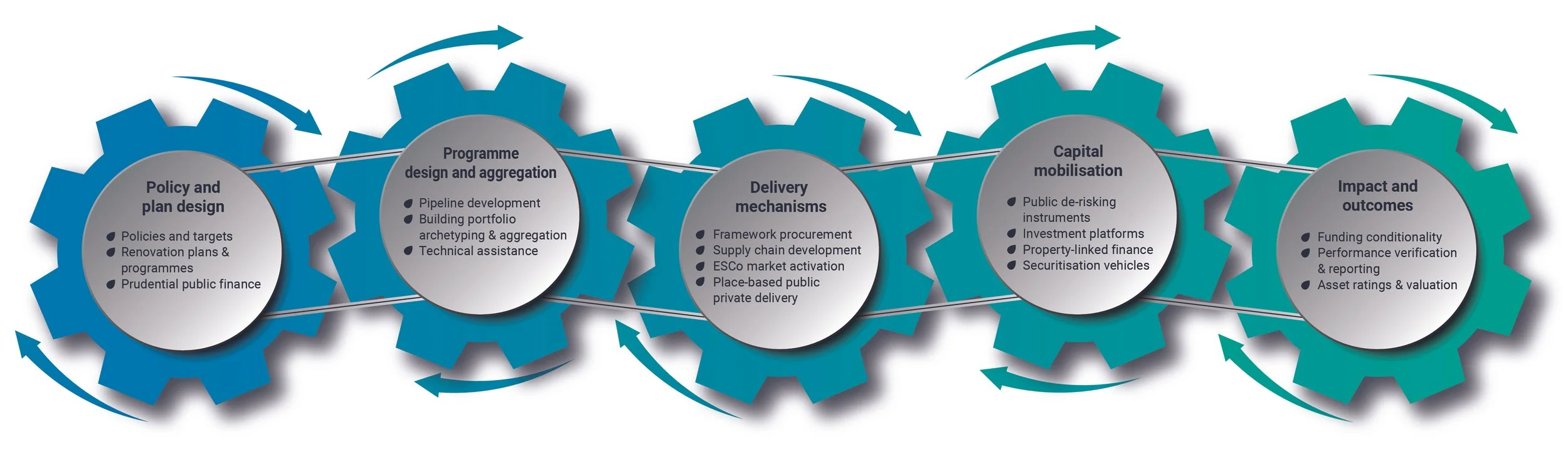
By integrating these functions into a coordinated implementation pipeline, the architecture aims to support more scalable renovation delivery, strengthen implementation capacity, improve public spending efficiency, and mobilise investment across Europe’s building stock.
“The challenge is no longer primarily one of target-setting. It is increasingly a question of how governments translate climate objectives into structured renovation programmes capable of mobilising investment and delivering projects at scale,” said Lina Konstantinopoulou, Executive Director of SEFA.
Why the Architecture Matters
For Governments
The Delivery Architecture helps governments strengthen implementation capacity for large-scale renovation programmes by improving coordination across policy, delivery systems, and financing structures. Through aggregation and standardisation, it can improve the efficiency of public spending, reduce transaction costs, support fiscally sustainable investment pathways, and help create investable renovation markets aligned with frameworks including the EPBD, NECPs, NBRPs, Social Climate Plans, the EU Affordable Housing agenda, and the GlobalABC Buildings Breakthrough.
For the Market
The architecture supports the development of more stable and investable renovation markets by improving pipeline visibility, strengthening delivery capacity across supply chains, and supporting the scaling of standardised procurement and performance-based delivery models. This can help mobilise ESCOs, contractors, technology providers, financial institutions, and institutional investors while supporting industrial capacity and workforce development across the renovation ecosystem.
For Citizens
The architecture helps address housing affordability and energy poverty by supporting large-scale renovation programmes capable of reducing delivery costs, transforming housing performance and improving access to financing. Through aggregation and economies of scale, the architecture can support more affordable, energy-efficient, resilient, and higher-quality housing outcomes for households and communities.
SEFA emphasises that the Delivery Architecture is not a new governance requirement or a single financing instrument, but a flexible implementation blueprint designed to be adaptable across national, regional, and municipal contexts, as well as public, residential, and commercial building segments. Effective deployment will ultimately require alignment with existing institutional frameworks, governance structures, regulatory systems, financing mechanisms, and market conditions within each jurisdiction.